What Happens When an Irish Dancer Has a Bad Night of Sleep Before a Major?
Sleep research insights for competitive Irish dancers and how they can protect their performance
INJURY PREVENTION & RECOVERYFEIS PREPARATIONMINDSET & MENTAL TRAINING
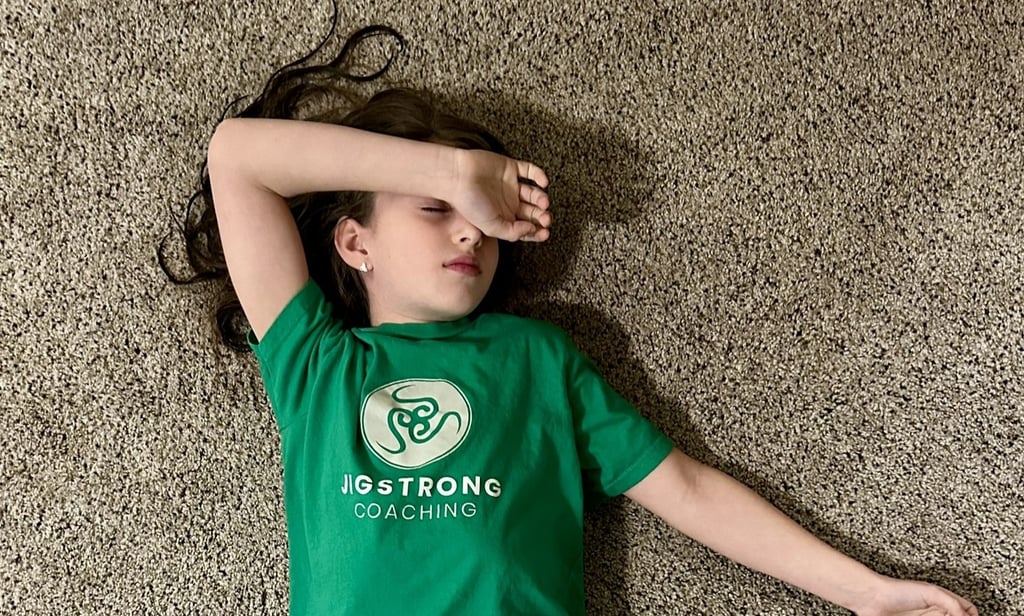
My post contentIt is common for dancers to experience partial sleep deprivation the night before a major due to nerves, travel, and being in an unfamiliar environment. Add the worry about getting enough sleep to the mix and it is a recipe for fractured sleep.
Does this mean you won’t have your best day?
There are currently zero published studies that have put Irish dancers in a sleep lab, however, we don’t need dancer-specific trials to know what happens. Competitive Irish dance is a near-perfect blend of two performance domains that have been studied: gymnastics and the 800-meter.
• Explosive anaerobic power (gymnastic jumps; plyometrics)
• Repeated high-intensity efforts lasting 30–120 seconds (800m)
• Extreme technical precision, motor control, and adjudicated skill execution (gymnastics, figure skating)
The physiological and neurological effects of acute sleep loss can be extrapolated.
Irish dance, like gymnastics and middle-distance running, relies on short routines and deeply ingrained motor patterns. These traits shape how sleep loss influences performance.
The Good News
Studies show that one night of partial sleep loss (4–5 hrs) usually has minimal impact on short, skill-based, well-practiced routines.
Your timing, rhythm, and motor patterns are highly automatic and hold up well, particularly for short-duration events.
Irish dancers spend years embodying the vocabulary and weeks to months rehearsing their choreography to the point that it becomes procedural, like riding a bike. That kind of motor memory does not disappear after one night.
Because dances usually last only 1-2 minutes, the quality and physiology is simply better preserved. There is minimal or no observable differences noted between performances after a full sleep and those after partial sleep. The excitement for the competition can also act as a buffer, its stimulating effect making up for drowsiness.
What Can Be Affected
Although the main elements of performance may stay intact, subtle changes can still occur.
Meta-analyses of one poor night of sleep (less than 6 hours) reveal that losing the last 3-4 hours of the night (from early wake-up, hotel noise, or anxiety) produces the largest performance drop documented across all sports.
If a dancer has difficulty falling asleep and the onset is delayed, they are better off than if they were to lose the last few hours of sleep, which is where the more restorative sleep occurs.
Even if overall performance stays solid, dancers may see small changes:
• Slower reaction time:
Judging timing on jumps, directional changes, and rhythmic adjustments is slightly slower. This can affect split-second transitions, quick foot articulations, and in-air adjustments.
• Less precise jumps and landings:
Explosive tasks are generally stable after one short night, but landing control and stiffness can be slightly compromised. This can show up as louder landings, heel drops, minor balance issues, and lower lift on jumps and extensions.
• More fine motor control issues:
Sleep loss can introduce small timing inconsistencies, making hard shoe rhythm sections less clear and movements less sharp.
• Reduced focus and cognitive alertness:
Irish dance competitions span multiple rounds, multiple hours, and, often, multiple days. Sleep loss affects sustained focus, emotional regulation, and next-day ability.
In tight competitions, these details matter. What’s more important is that all of this can increase the risk for injury.
While this may sound like it will result in a bad day, and we know for certain that sleep is imperative for long-term training, recovery, and injury prevention, a single poor night rarely ruins competition performance!
These effects are small and manageable.
The change most likely to be experienced is the polish. And dancers can counteract these subtle effects with simple, evidence-supported tactics.
Mitigation Strategies
Try banking sleep (getting 8+ hours) 2-3 nights before the day of your championship. Avoid alarm clocks and use blackout curtains. Allow yourself to sleep as much as you can to build up a little resilience if you end up with insomnia.
If you do suffer from a bad night’s sleep and you are anxious about its effects, there are some tactics one can employ.
Quick ways to restore sharpness:
• Longer warm-up (+5–10 min), focusing on technical drills, rhythm sections, and ankle stability)
• Power nap (20–45 min, before your comp if you’re dancing in the afternoon)
• Fuel early and on time (carbs and protein will help the body feel energized)
These compensate for the subtle effects of poor sleep.
What About Caffeine?
Caffeine is a well-studied stimulant that has demonstrable effects as a performance enhancer.
Adults may want to consider caffeine to blunt the effects of lack of sleep:
For adult dancers:
• 1–3 mg/kg → ~80–200 mg for most
• Take 30–60 min before you go on stage
• Avoid high doses (can cause jitters, bathroom runs, and a higher heart rate)
• Rehydrate well
Youth Dancers and Caffeine
Note: I strongly advise against giving caffeine supplements or energy drinks to kids. Please never let any competition stand in the way of parental judgement. Always do what is safe, even if it might mean a sub-par performance.
Teens metabolize caffeine differently and are more sensitive to its effects.
For teens:
• Use only with parent/doctor/coach guidance
• If appropriate: ~1 mg/kg
• Prefer tea or a small coffee
• NO energy drinks
• No late-day caffeine if the dancer is also to compete the next day
Youth ought to rely more on naps, warm-up, snacks, and technique reinforcement than stimulants.
The Bottom Line
One shortened sleep does not ruin your competition. Most of the core performance is protected by training. With smart strategies (and some radical acceptance!), you can compete at expected levels.
Your training—not one night—determines your success.
Social
Phone
info@jigstrongcoaching.com
+1 415 301 0043
© JigStrong Coahing 2025. All rights reserved.