
The Science of Warming Up for Irish Dance
How to construct the perfect warmup for class and competition
INJURY PREVENTION & RECOVERYSTRENGTH & CONDITIONINGFEIS PREPARATION
When you watch an Irish dancer fly across the stage, the performance looks artistic and (hopefully) effortless, but physiologically, it’s closer to running an 800-meter race than you might think.
Like the 800m, Irish dancing sits at the crossroads of speed, power, and endurance. It is a hybrid event: highly technical, neuromuscularly demanding, and powered by both anaerobic and aerobic systems. That’s exactly why the warmup is not optional; it functions as both performance enhancer and injury prevention.
Dancers often underestimate just how much of an athlete they are, and how they ought to treat their bodies like a middle-distance runner. Many expect their bodies to perform right away. Others think a few stretches is sufficient. While still others believe they need to follow a long, drawn-out protocol that includes rollers, bands, and light weights demonstrated by their favorite social media influencer and still worry they’re not yet prepared.
Are you confused about how to warm up for competition? Should it be the same as practice? Are you even getting an appropriate warmup for class?
What is the right warmup for Irish dancers?
The answer is that, while it does depend on the event (ie. is it for class or for a competition?), individual physiology, the current state of fatigue and recovery, and age and experience, every warmup should follow the RAMP protocol.
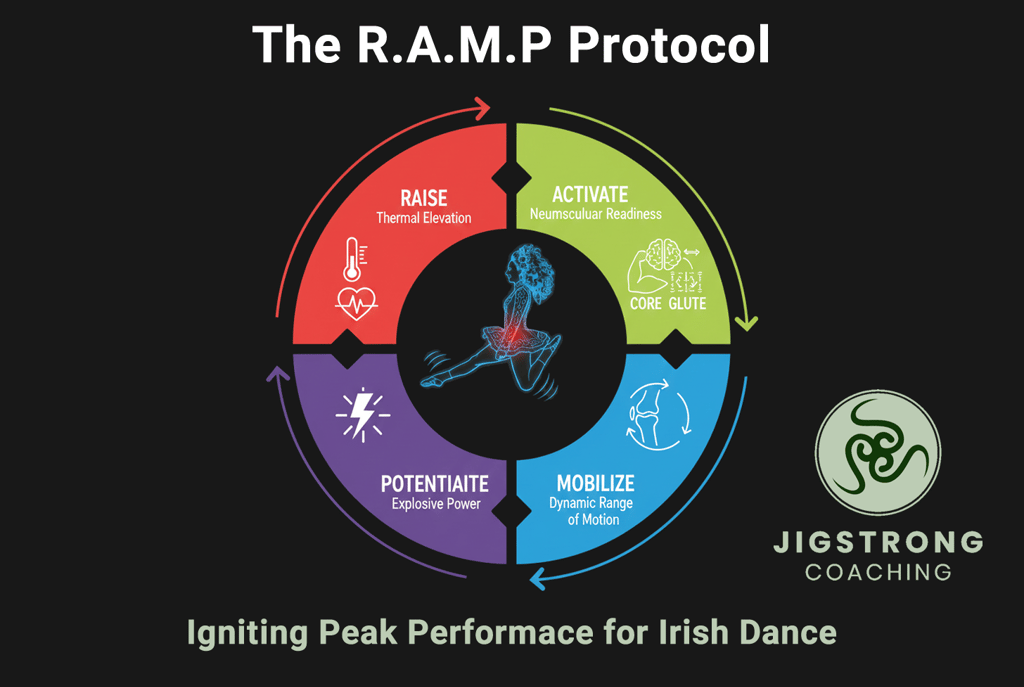
The RAMP protocol is a phase-based warmup system that stands for Raise, Activate and Mobilize, and Potentiate. It is intended to prepare the body for vigorous physical activity.
The Physiology Behind the Warmup
1. Neuromuscular readiness
Irish dancing requires footwork precision, controlled posture, explosive jumps, rapid limb stiffness adjustments, and fine motor timing.
A gradual warmup increases motor unit recruitment efficiency and improves “rate coding,” how fast your nervous system can fire signals to the muscles. Without this, dancers feel sluggish, sloppy, and unstable.
2. Metabolic activation
Dancing full rounds relies heavily on:
Phosphocreatine system (0–10 seconds) for explosive jumps
Fast glycolysis (10–45 seconds) for high-intensity sequences
Aerobic support for longer rounds (slip jigs, hornpipes, and sets), recovery between rounds, and multi-hour classes.
A warmup increases the rate of ATP turnover, priming these pathways so your body can access energy rapidly.
3. Tissue elasticity and force production
As muscle temperature rises, collagen fibers become more pliable, tendons store elastic energy more effectively, and injury risk decreases, especially in the Achilles, calves, pes anserine, and hip flexors (major risk zones for Irish dancers).
R.A.M.P. Phases:
1. Raise — Thermal Elevation and System Activation
This is the cornerstone of every effective warmup. It begins with low-intensity movement aimed at increasing muscle and core temperature. This leads to:
Faster nerve conduction
More efficient muscle contraction/relaxation cycles
Increased metabolic enzyme activity (ATP turnover)
Improved oxygen kinetics
Better tendon elasticity and recoil
Reduced injury risk
Warmer muscles are more elastic, contract more forcefully, and relax more quickly. Without raising body temperature, tissues are not as pliable and motor units are not primed, which increases the risk of strains.
The increase in blood flow delivers oxygen and nutrients to working muscles and removes metabolic waste products more efficiently. This phase is non-negotiable for explosive sports.
2. and 3. Activate and Mobilize — Neuromuscular Stability and Dynamic Range of Motion
Irish dancers rely heavily on:
rapid motor unit recruitment
excellent proprioception
deep-core and pelvic stability
glute activation
ankle–foot stiffness control
Fine motor control and fast foot movements demand a highly “awake” nervous system. This phase activates the small stabilizers and sets the foundation for technique.
Irish dancing also requires a unique combination of:
strong turnout
hip mobility
ankle mobility
upright spinal posture
dynamic leg extension and flexion
Dynamic mobility—not static stretching—is what improves movement quality before a performance. It allows dancers to hit lines and clean beats without losing tension or stability.
4. Potentiate — Explosive Power and Competition Readiness
This is where the warmup begins to mirror the specificity and intensity of dancing. Short, controlled bursts of high-speed movement:
stimulate the anaerobic glycolytic system
improve rate of force development
sharpen timing and rhythm
prepare tendons for reactive forces
increase confidence and readiness
Like 800m runners, dancers must “prime,” not fatigue themselves.
Class Warmups and Daily Training (15-20 minutes)
These are designed to safely prepare dancers for technique work, drills, and moderate intensity dance practice. A class warmup is usually shorter than what is best for competition.
R — Raise (5–7 minutes)
Purpose: elevate heart rate and increase muscle temperature.
Goal: break a light sweat.
This is the most critical phase and the one dancers often skip.
Examples:
Light jog or skipping – 2 minutes
Lateral shuffles – 1 minute
Fast feet in place – 30 seconds
Light jump rope – 1–2 minutes
High knees or marching – 30–45 seconds
A — Activate (3-5 minutes)
Purpose: wake up stabilizers, foot muscles, glutes, and posture.
Goal: Focus on precision, not intensity.
Examples:
Feet:
Foot articulation and ankle circles
Relevé holds and pulses
Short-range calf raises
Toe scrunches and foot yoga
Quick ankle hops
Hips and Core:
Clamshells or standing turnout pulses
Good mornings
Glute med activation (side steps or banded step-outs)
Glute bridge
M — Mobilize (3-5 minutes)
Purpose: improve dynamic mobility while preserving tension and stability.
Examples:
Dynamic Mobility Drills
Leg swings (front/back + side)
Lunge with twist
Hamstring sweeps
Hip circles
Cat-cow or spine articulations
Avoid static stretches that last longer than 15 seconds; save long holds for post-workout.
P — Potentiate (3-5 minutes)
Purpose: activate anaerobic pathways and central nervous system; access power, sharpen, and ready without fatigue.
Examples:
Vertical hops (low → medium)
Light single-leg jumps
8-16 bars of a dance at 10-80% effort
1–2 short bursts of a key step at 70–90% effort
1 step near-performance effort
This is identical to the “strides” runners do before racing. Dancers should feel awake, sharp, and powerful. The muscles should be warmed and excited, not fatigued or heavy after this phase.
Competition Warmup (20-35 minutes)
This warmup is more extensive and is aimed at peak performance.
R — Raise (5-10 min)
A — Activate (5-8min)
M — Mobilize (5-8 min)
P — Potentiate (5-10 min)
The goal is high-intensity nervous-system priming.
Rest 2–3 minutes before performing. Revisit the high knees, leg swings, mobility, and some light bouncing, such as butt kick jumps, to maintain muscle temperature between rounds, and when you are one dancer 2 dancers out from going on stage.
The Takeaway
You do not need a very long warmup for class. Some dancers warm up quickly and are ready to go in 5 minutes and some do need a bit longer. But because class will take you through skips and jumps, you want to just be warm enough to begin them.
Sometimes if a dancer is taking longer than 10-15 minutes to feel snappy, it is actually an indication of fatigue and that their muscles are not fully recovered. This means the dancer might want to take it easy or, perhaps, even need more calories! The body has energy in a fed state. Being underfueled leads dancers to be in an energy deficit, which will prevent adaptation and adds more stress to the system.
For competition, there is not a long class at the end of the warmup. It is the moment you need to perform your best. This is where a longer warmup is necessary. It does not need to be a full 35 minutes! But you should take at least 20 minutes to gradually turn on your body’s systems and feel sweaty and warm and ready to go!
Lastly, beginners and youths have different needs than adults and elite dancers. Beginners and youths can get away with slightly shorter warmups, while more advanced dancers and adults need more time to be fully prepared for intense work. This requires some trial and error and/or the guidance of an experienced coach to tailor the warmup to you, the individual.
Social
Phone
info@jigstrongcoaching.com
+1 415 301 0043
© JigStrong Coahing 2025. All rights reserved.